The Fundraising Engine: Why Retention Is the Metric That Actually Matters
Most nonprofits track total dollars raised. It shows up in board reports, gets announced at galas, and makes for nice year-over-year comparisons. But that number tells you almost nothing about whether your fundraising is actually sustainable.
Total dollars raised is a lagging indicator. By the time it looks bad, you're already in trouble. The metrics that matter are the ones that tell you where you're headed, not where you've been.
The Retention Problem Nobody Wants to Talk About
Here's a number that should concern every nonprofit leader: according to the Fundraising Effectiveness Project's Q4 2024 data, only 19.4% of first-time donors gave again the following year. That means 4 out of 5 new donors never come back.
The overall average donor retention rate sits around 43%, which means the typical nonprofit replaces nearly half its donor base every single year. And that number has been declining in recent years.
This creates what researchers call the "leaky bucket" problem. You pour resources into acquiring new donors, but an even larger share slips out the bottom. You end up running just to stay in place.
Why Retention Beats Acquisition
The economics are clear. Research consistently shows acquiring new donors costs several times more than retaining existing ones. Most estimates put the difference at 5 to 10 times the cost.
But the math gets even more compelling when you look at behavior patterns. According to the Fundraising Effectiveness Project, one-time donors have a retention rate of just 13.9%. Get that second gift, and retention jumps to 30%. By the time someone has given three to six times, you're looking at 55% retention. Donors who've given seven or more times? They stick around at a rate of 86%.
The implication is straightforward: the single most important thing you can do for your fundraising sustainability is convert first-time donors into second-time donors. That one conversion nearly doubles your chances of keeping them.
Lifetime Value: The Number That Changes Everything
When you shift from thinking about individual gifts to thinking about donor lifetime value, your entire approach changes.
Lifetime value is straightforward to calculate: average gift amount multiplied by giving frequency multiplied by donor lifespan. If a donor gives $50 twice a year and stays with you for four years, their lifetime value is $400.
But here's where it gets interesting. Research shows that long-term donors who give consistently for five or more years contribute dramatically more than one-time donors, often making up the majority of total revenue.
This is why chasing one-time gifts is such a losing strategy. A $500 gift from someone who never gives again is worth less than a $50 donor who sticks around for a decade.
The Recurring Giving Advantage
Recurring donors are a different category entirely. Industry data shows recurring donors give significantly more per year, have much higher retention rates, and stay connected to organizations far longer than one-time donors.
Run those numbers. A recurring donor who gives $50 monthly for five years contributes $3,000 in lifetime value. Compare that to a one-time donor who gives $100 and never returns.
And here's something that should get your attention: even as individual giving has been declining, the number of recurring donors has grown substantially over the past several years. Donors are increasingly comfortable with subscription-style giving. The question is whether you're making it easy for them.
The Four Metrics to Watch
Based on the research, here are the fundraising metrics that actually predict sustainability:
Donor retention rate. What percentage of last year's donors gave again this year? If you're below 40%, you're on a treadmill. Above 50% puts you ahead of most organizations.
First-time donor retention. This is your leading indicator. If you can get 25% or more of new donors to give a second gift, you're building something sustainable. Below 20%, and you're fighting gravity.
Recurring donor percentage. What share of your donors give monthly or annually on a recurring basis? These supporters are your most valuable, most stable revenue source. Track this number and work to grow it.
Donor lifetime value. This requires knowing your average gift, frequency, and donor lifespan. Most CRMs can calculate this. If you don't know your LTV, you're making acquisition and retention decisions blind.
What This Means for Your Dashboard
If you're building a fundraising dashboard, these are the numbers that belong on it. Total dollars raised can be there too, but it shouldn't be the headline.
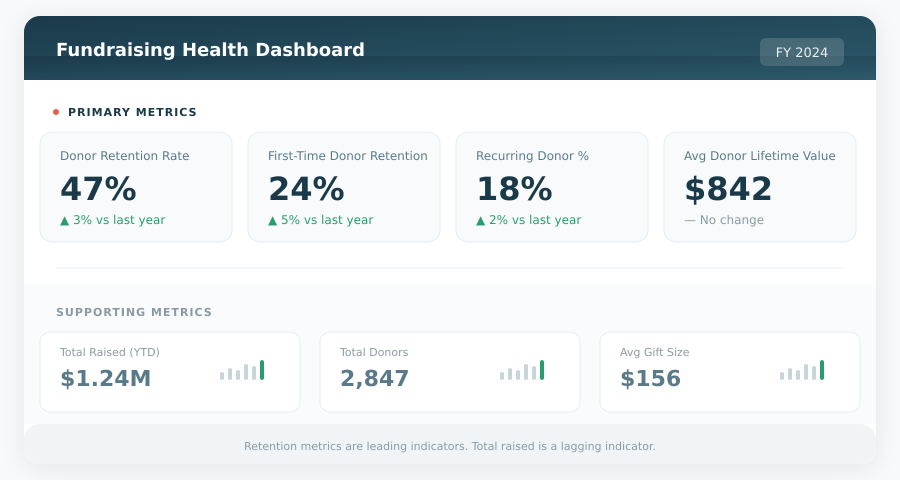
The goal is to see trends before they show up in your revenue numbers. If retention starts dropping in Q2, you have time to do something about it before year-end totals look bad.
The Uncomfortable Truth
Most nonprofit fundraising programs are structured around acquisition. The annual fund push, the year-end appeal, the gala, the peer-to-peer campaign. All of these focus primarily on bringing in new donors or extracting one-time gifts.
Very few organizations invest proportionally in retention. Stewardship programs exist, but they're often an afterthought. The development team celebrates a $10,000 gift but doesn't track whether that donor ever gives again.
This isn't a criticism of development professionals. It's how the field has traditionally operated. But the data suggests it's backwards. An organization that retains 60% of donors will, over time, dramatically outperform one that retains 40%, even if the second organization is better at acquisition.
Starting Point
If you don't currently track donor retention, start there. Pull last year's donor list and this year's donor list. See how much overlap exists. That one number will tell you more about your fundraising health than total dollars raised ever could.
Then look at your first-time donors specifically. How many of them came back? If the answer is uncomfortable, that's where to focus.
The fundraising engine runs on retention. Everything else is just filling the bucket.